
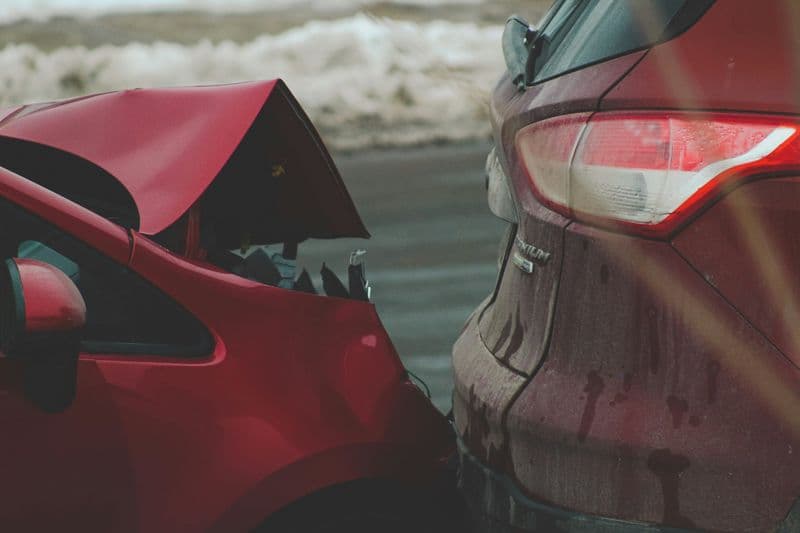
Rear-end accidents can cause serious harm to your health, including whiplash, traumatic brain injury, and spinal cord injury, among other devastating injuries.
When a rear-end crash happens, it becomes important to understand your legal rights. Canopy Legal Group can help.
We understand the laws governing these crashes, will work with you to identify who is to blame, and can help you navigate the legal system to recover the compensation you deserve. And we won’t charge legal fees unless we win.
Give us a call today to schedule a free consultation with a rear-end accident lawyer and learn more about the help and support we can offer.
Who is responsible for a rear-end accident?
There is a common misconception that a rear-end accident is always the fault of the driver in the rear vehicle. That’s because drivers are expected to leave a safe amount of distance between their own vehicle and the car in front of them. If someone is leaving a safe distance, they should be able to react and stop when the car in front of them does.
Because of this expectation, it’s true that there is often a rebuttable presumption that the driver in the rear is to blame. This means that the assumption in most circumstances is that the rear driver was negligent.
However, that presumption can be rebutted. The key is that the burden of proof shifts. In a normal car accident claim, the driver making the damage claim must prove that the defendant was negligent and should be held liable for losses. When a claim arises out of a rear-end accident, though, if the driver in the rear vehicle is sued, that driver would need to present evidence showing why they weren’t negligent to escape liability for losses.
This could include showing that:
- The driver in the front vehicle reversed into oncoming traffic, leaving the rear driver no choice but to collide
- The driver in the front vehicle engaged in irresponsible or reckless behavior that caused or contributed to the accident
- The taillights on the front vehicle failed to work, so the driver in the rear had no warning that the leading vehicle was about to slow down or stop
- The driver in the front vehicle merged unsafely, cutting off the driver in the rear vehicle and leaving no opportunity to stop the car on time
Whether you are the driver in the front or the rear vehicle, Canopy Legal can help you to understand the rebuttable presumption of negligence that often applies in rear-end accident cases and can help you to work within this legal framework to show why the other driver was to blame for your losses.
What if both drivers share fault for a rear-end accident?
In some cases, both the driver in the front vehicle and the one in the rear vehicle share responsibility for causing the crash. In these circumstances, the state’s comparative or contributory negligence rules will apply to determine if a crash victim can pursue a claim.
Most states follow either pure or modified comparative fault rules. In pure comparative fault states, if the other driver was even a small percentage responsible for an accident that harmed you, you can pursue a claim for partial damages. So, if the driver in the front vehicle was 5% to blame for harming you, you could pursue a claim to recover for 5% of your damages.
In modified comparative fault rules, you’d be able to pursue a claim for partial damages only if the other driver was at least 50% or at least 51% responsible for harming you.
And in contributory negligence states (of which there are very few), you’d be unable to pursue a claim to recover any damages if you were even 1% at fault for the crash.
Getting help from a rear-end accident lawyer
At Canopy Legal, we’ll help you to understand who is likely to be blamed for your accident and what legal rules apply that affect your right to compensation.
We’ll work with you to gather evidence of liability and to prove the extent of your damages so you can maximize the chances of getting the money you deserve.
Our team will be there for you from day one, gathering evidence from the crash scene, interviewing witnesses, obtaining medical records, negotiating with insurers, and fighting for you. And we won’t charge legal fees unless we win.
To learn more about how our rear-end accident lawyers can help you in your pursuit of justice, give us a call or contact us online today.